Best Cat Beds in 2026
Compare the best cat beds for curling, warmth, hiding and everyday naps. Research-based picks plus tips on size, placement, materials and cleaning.
📅 August 9, 2026
Compare space-conscious cat litter boxes for small apartments, including compact top-entry, covered front-entry and automated options with footprint trade-offs.
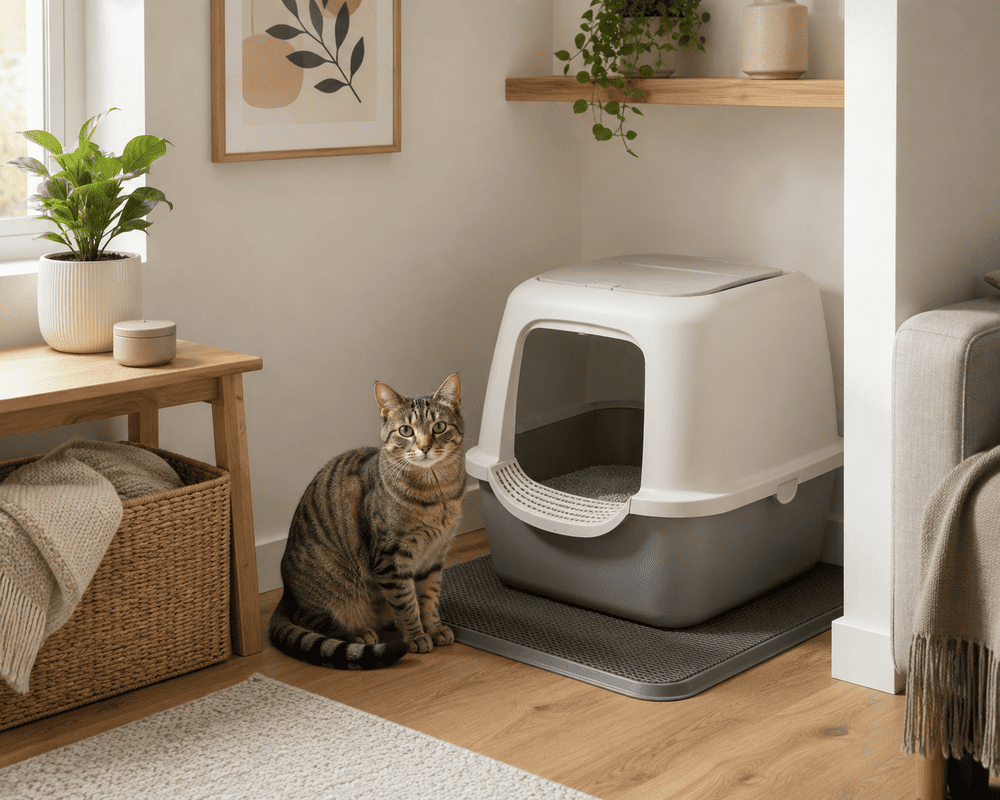
In a small apartment, the litter box has to fit the cat first and the room second. The most compact footprint is not automatically the best choice if the entry is difficult, the interior is cramped or the design makes daily scooping inconvenient. Odor control also depends heavily on frequent waste removal and litter maintenance, not just whether the box has a lid.
| Product | Best for | Why it stands out |
|---|---|---|
| Modkat Top-Entry Litter Box | tight floor space and litter tracking control | Modkat specifically describes this as a compact top-entry litter box for tight spaces. Its footprint is about 16 by 16 inches, and the top-entry design keeps the entire access path within that square footprint while helping reduce litter tracking. |
| Modkat Flip Litter Box | covered front entry with easier scooping access | Flip uses a front entry and a three-position lid, giving owners more flexibility than a fixed hood. It measures about 20.5 by 15.8 by 16.8 inches, so it uses more length than the top-entry Modkat but remains relatively tidy in shape. |
| Whisker Litter-Robot 4 | automation when the apartment has dedicated floor space | Litter-Robot 4 is not the smallest option, but it is relevant for apartments because automatic waste separation can reduce the amount of time waste remains exposed. Its official footprint is about 22 by 27 inches and it is 29.5 inches tall, so measuring is essential before treating it as a “space-saving” solution. |
We started with the real buying decision rather than a popularity list. The shortlist favors products with current manufacturer documentation and compares the features that materially affect fit, safety, maintenance, reliability and everyday use. We also call out limitations because a product can be well made and still be wrong for a particular dog, cat, home or routine.
Modkat specifically describes this as a compact top-entry litter box for tight spaces. Its footprint is about 16 by 16 inches, and the top-entry design keeps the entire access path within that square footprint while helping reduce litter tracking.
Key features: 16 x 16 x 15 inch overall size; top entry; swivel lid; seamless base; reusable liner; intended for cats up to about 12 lb according to the manufacturer.
Advantages: Small square footprint, reduced tracking and a clean exterior shape that can fit more easily into corners.
Limitations: Top entry may be unsuitable for cats with mobility limitations, large cats or cats that simply refuse to enter from above.
Who should choose it: Choose it for a healthy, appropriately sized cat that already tolerates top-entry boxes and for rooms where floor footprint is the limiting factor.
Who should skip it: Skip it for a senior/arthritic cat, a large cat or any cat that strongly prefers front entry.
Flip uses a front entry and a three-position lid, giving owners more flexibility than a fixed hood. It measures about 20.5 by 15.8 by 16.8 inches, so it uses more length than the top-entry Modkat but remains relatively tidy in shape.
Key features: Front entry; 3-position lid; 20.5 x 15.8 x 16.8 inch size; seamless base; reusable liner; hanging scoop.
Advantages: Front entry is easier for many cats, lid opens for daily cleaning and the tall base helps contain side urination.
Limitations: Longer footprint than the top-entry model and covered layouts are not preferred by every cat.
Who should choose it: Choose it when your cat needs front entry but you still want a clean covered footprint and easy lid access.
Who should skip it: Skip it if your cat avoids covered boxes or needs a very low entry.
Litter-Robot 4 is not the smallest option, but it is relevant for apartments because automatic waste separation can reduce the amount of time waste remains exposed. Its official footprint is about 22 by 27 inches and it is 29.5 inches tall, so measuring is essential before treating it as a “space-saving” solution.
Key features: 22 x 27 inch footprint; 29.5-inch height; automatic sifting; waste drawer; app-connected monitoring; arrives assembled.
Advantages: Automates scooping cycles and consolidates waste into a drawer, which can be convenient in a small home if the unit fits.
Limitations: Large vertical/overall footprint, premium cost, requires power and is much less discreet than a basic compact box.
Who should choose it: Choose it only if automation is worth dedicating a roughly 22-by-27-inch floor area to the unit.
Who should skip it: Skip it if your apartment cannot comfortably accommodate the footprint or you want the simplest possible box.
The cat should be able to enter, turn and eliminate comfortably. Do not shrink the box below what your individual cat can use comfortably just to save floor area.
Top-entry designs save certain kinds of space and reduce tracking, but front/open entry is easier for many senior, large or mobility-limited cats.
A compact box that is frustrating to scoop may be cleaned less often. Hinged/removable lids and simple liners can improve daily maintenance.
A hood can contain some litter scatter but does not remove the need for frequent scooping. In a small apartment, timely waste removal matters more than perfume or a closed lid.
Avoid putting the only litter box in a noisy, inaccessible or hard-to-reach corner simply because it is visually hidden.
They can use floor space efficiently and reduce tracking, but only if the cat can comfortably jump in and out and accepts that entry style.
They may contain some odor around the box, but frequent scooping, the litter itself, ventilation and cleaning have a larger effect on the room environment.
It can reduce manual scooping, but automatic models are often physically large and need power. Measure the real footprint and height before buying.
We verify product names and category-defining specifications against current manufacturer information, distinguish research from hands-on testing, and focus on the trade-offs a buyer can actually use. When an app, battery, subscription, replacement part, compatible consumable or specific fit requirement is central to a product, that dependency belongs in the comparison rather than being hidden in fine print.
Pet-product information can change after publication. Recheck current sizing, compatibility, care and safety instructions before purchase. Product guides are general information and are not a substitute for veterinary advice when a pet has a medical, mobility, nutrition or behavior concern.
For the smallest square footprint, Modkat Top-Entry is the strongest space-focused choice for a suitable cat. Modkat Flip is better when front entry matters. Litter-Robot 4 makes sense only when automation is valuable enough to justify its much larger footprint.
Compare the best cat beds for curling, warmth, hiding and everyday naps. Research-based picks plus tips on size, placement, materials and cleaning.
Compare the best cat trees for climbing, scratching, lounging, large cats and small spaces. Research-based picks plus stability and placement advice.
Compare the best self-cleaning litter boxes for odor control, multi-cat homes, open designs and easier maintenance. Research-based 2026 guide.